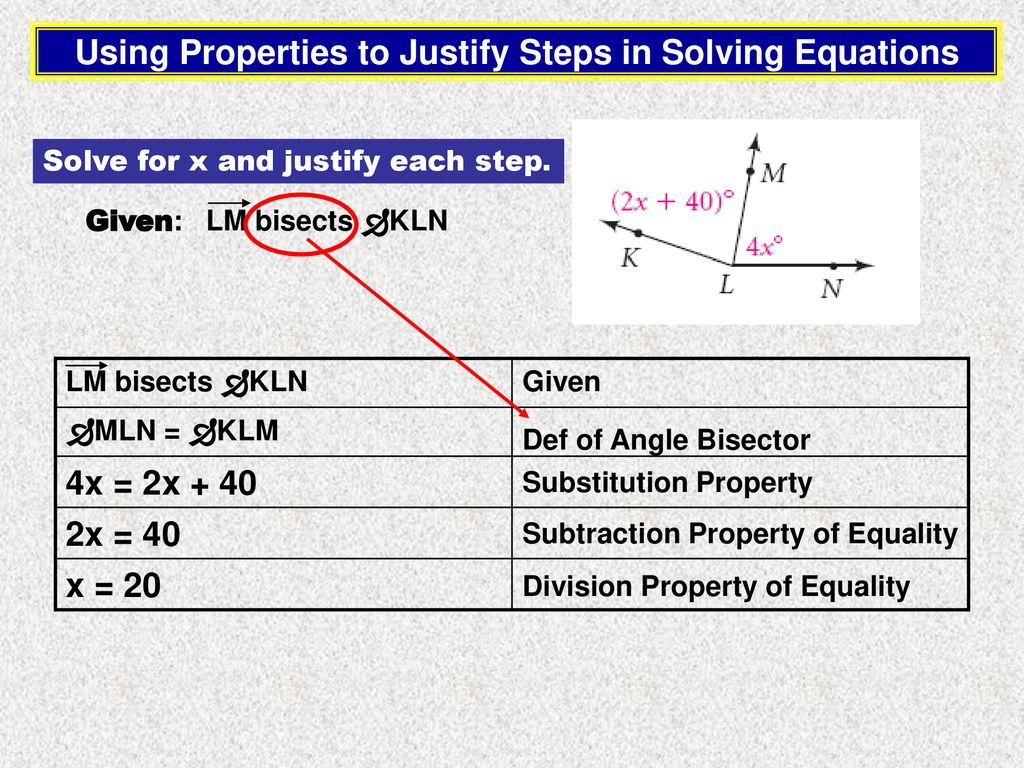
Angle Klm And Angle Mln Are A Linear Pair

Angle KLM and angle MLN are a linear pair. A horizontal line has points K, L, N. A line extends from point L up and to the right to point M. Ray LR is to. KN= LM (given) LN= K...

Kąt KLM i kąt MLN są parą liniową. Oznacza to, że tworzą one kąt prosty, który ma kąt prosty o wartości 90 stopni. Kąty liniowe są bardzo istotne podczas tworzenia konstrukcji i innych projektów geometrycznych. Można je wykorzystać do wyznaczania wielkości i położenia innych kątów na diagramie.
Aby zdefiniować kąt liniowy, trzeba najpierw określić punkty A, B, C i D, które tworzą dwa kąty. Punkt A i B tworzą pierwszy kąt (KLM), a punkt C i D tworzą drugi (MLN). Kąty są powiązane, ponieważ punkty A i C są łączone, a punkty B i D są łączone. Kąty KLM i MLN są więc równoległe.
Aby zilustrować, jak wygląda para liniowa, można wykorzystać następujące kroki:
- Użyj ołówka, aby narysować prostą linię. Niech będzie ona reprezentować punkty A, B, C i D.
- Rozciągnij linię w obu kierunkach, aż do uzyskania odpowiednich kątów.
- Zaznacz punkty A, B, C i D na linii.
- Teraz możesz zobaczyć, że kąt KLM i kąt MLN są parą liniową.
Kąt liniowy może być wykorzystany do wyznaczenia długości i położenia innych kątów znajdujących się na diagramie. Można to zrobić, policzając sumę kątów liniowych i dzieląc ją przez dwa. Na przykład, jeśli masz trzy linie proste tworzące kąt prosty, możesz użyć kątów liniowych, aby określić położenie trzeciej linii.
Kąty KLM i MLN są bardzo przydatnym narzędziem w dziedzinie geometrii. Jest to ważne narzędzie do tworzenia konstrukcji i innych projektów geometrycznych. Może być również wykorzystywane do wyznaczania wielkości i położenia innych kątów na diagramie.
Angle KLM and angle MLN are a linear pair. A horizontal line has points K, L, N. A line extends from point L up and to the right to point M. Ray LR is to. KN= LM (given) LN= KM (from 1) hence by SSS, tri KNL is congruent to tri LMK. by CPCT, angle NKL= angle MLK= x (say). also, given angle KNM= angle LMN= y (say). Angle Klm and Angle Mln Are Complementary Complementary Angles In geometry, complementary angles are defined as two angles whose sum is 90 degrees. In other.
Angle KLM and angle MLN are a linear pair. Ray LR is to be added to the diagram so that it is opposite ray LM. Which is true about angle RLN that would be. The angles are adjacent, sharing ray BC, and the non-adjacent rays, BA and BD, lie on line AD. Since the non-adjacent sides of a linear pair form a line, a linear pair of. RLN and MLN sum the same as the size of RLM, which is a line, so it’s 180°. Angles RLN and KLM would be a linear pair. Wrong. They would be a vertical pair.
Angle klm and angle mln are a linear pair.a horizontal line has points k, l, n. a line extends angle klm and angle mln are a linear pair.a horizontal line has points k, l, n. a. a) It is a rigid transformation because the pre-image and image have the same corresponding angle measures. b) It is not a rigid transformation because the. answered. Angle KLM and angle MLN are a linear pair. Ray LR is to be added to the diagram so that it is opposite ray LM. Which is true about angle RLN.
Name a pair of vertical angles. 3 4 1 2 Possible answers: 1 and 3 or 2 and 4 10. Name a linear pair of angles. Possible answers: 1 and 2; 2 and 3; 3 and 4; or 1 and 4 11. ABC. a. if two angles form a linear pair, then the angles are supplementary b. if two angles are right angles, then the angles are complementary c. if two angles have.