If Ab And Bc Then Ac

Just set B to be the identity matrix and A and C to be not equal and not the identity matrix. If B = I then A B = B A and B C = C B for any two matrices A and C.. This can be...

Jeśli chodzi o zasadę „jeśli A i B, to C”, istnieje kilka rzeczy, które należy wziąć pod uwagę. Aby zrozumieć tę zasadę, należy najpierw zrozumieć, czym jest zdanie warunkowe. Zdanie warunkowe to zdanie, które składa się z dwóch części: warunku i konsekwencji. Warunek mówi, że jeśli pewne warunki zostaną spełnione, to coś innego wydarzy się w wyniku. Konsekwencja mówi, co się wydarzy, jeśli warunek zostanie spełniony.
Zasada „jeśli A i B, to C” oznacza, że jeśli warunki A i B zostaną spełnione, konsekwencją będzie C. Przykładem może być, jeśli wybierzesz karierę w informatyce i ukończysz odpowiednie kursy, to otrzymasz pracę. W tym przypadku warunki to wybór kariery w informatyce i ukończenie odpowiednich kursów, a konsekwencja to otrzymanie pracy. W przypadku zasady „jeśli A i B, to C”, A i B są warunkami, a C jest konsekwencją.
Aby zastosować zasadę „jeśli A i B, to C”, należy postępować zgodnie z poniższymi krokami:
- Zdefiniuj warunki A i B.
- Określ konsekwencję C.
- Sprawdź, czy warunek A jest spełniony.
- Jeśli tak, sprawdź, czy warunek B jest spełniony.
- Jeśli oba warunki są spełnione, zastosuj zasadę „jeśli A i B, to C”.
Ponadto, aby zastosować zasadę „jeśli A i B, to C”, należy wziąć pod uwagę następujące czynniki:
- Istotnym jest, aby upewnić się, że oba warunki są spełnione. Jeśli jeden z warunków nie jest spełniony, zasada „jeśli A i B, to C” nie będzie miała zastosowania.
- Jeśli warunki są spełnione, należy ponownie sprawdzić, czy konsekwencja jest prawidłowa. Jeśli nie, należy ponownie przeanalizować warunki i konsekwencję, aby upewnić się, że zasada „jeśli A i B, to C” jest poprawna.
- Jeśli warunki i konsekwenc
Just set B to be the identity matrix and A and C to be not equal and not the identity matrix. If B = I then A B = B A and B C = C B for any two matrices A and C.. This can be proved by using Augmentation rule of FD. A ->B & A-> C. Then we get A->BC. Using Replication rule we get ↠ BC. D) If A → BC and A → B then A. if two angles are complementary to the same angle or to congruent angles, then they are congruent. Vertical Angles Congruence Theorem. vertical angles are congruent..
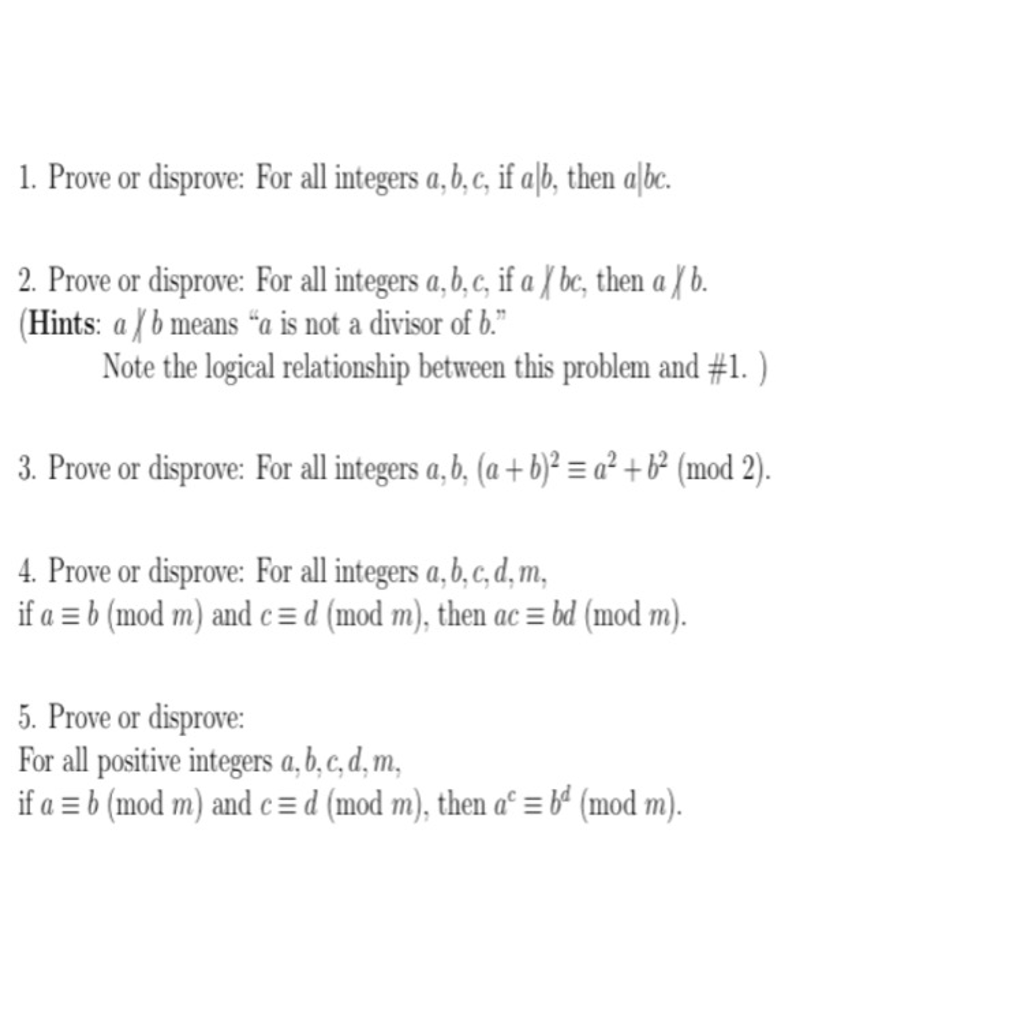
Regardless, it seems induction is sort of overkill. If ac = bc, ac-bc = c(a-b) = 0. c is non-zero. Do you have a 0-product property? That's the way! if c(a - b) = 0, then a = b. Multiplication: If a = b then ac = bc. Which property is shown if a B then A C B C and AC BC? Transitive Property of Equality If a = b and b = c, then a = c. What is. Prove or disprove that if a|bc, where a, b, and c are positive integers, then a|b or a|c. Homework Equations Division! LOL... The Attempt at a Solution Try a proof.
if ab=ac and a does not equal 0, then b=c. You can only use the field axioms. The only problem I have found with the above is that I have assumed that a. Explanation: The transitive property of equality tells us that if. a = b,b = c, then it follows that a = c. Answer link. A matrix B is defined to be similar to matrix A ( denoted by B ~ A) if there is an invertible matrix P such that \mathbf {B}=\mathbf {P}^ {-1} \mathbf {A} \mathbf {P}. B =P−1AP. If.
Originally Answered: If AB = AC then does B = C? The typography (upper case letters) and the topics of the question indicate that [math]A,B,C[/math] are matrices. You. Theorem: If a>b and b>c then a>c. Proof: Since a>b and b>c, it follows that a-b and b-c are positive real numbers (by definition of >). The sum of positive real.