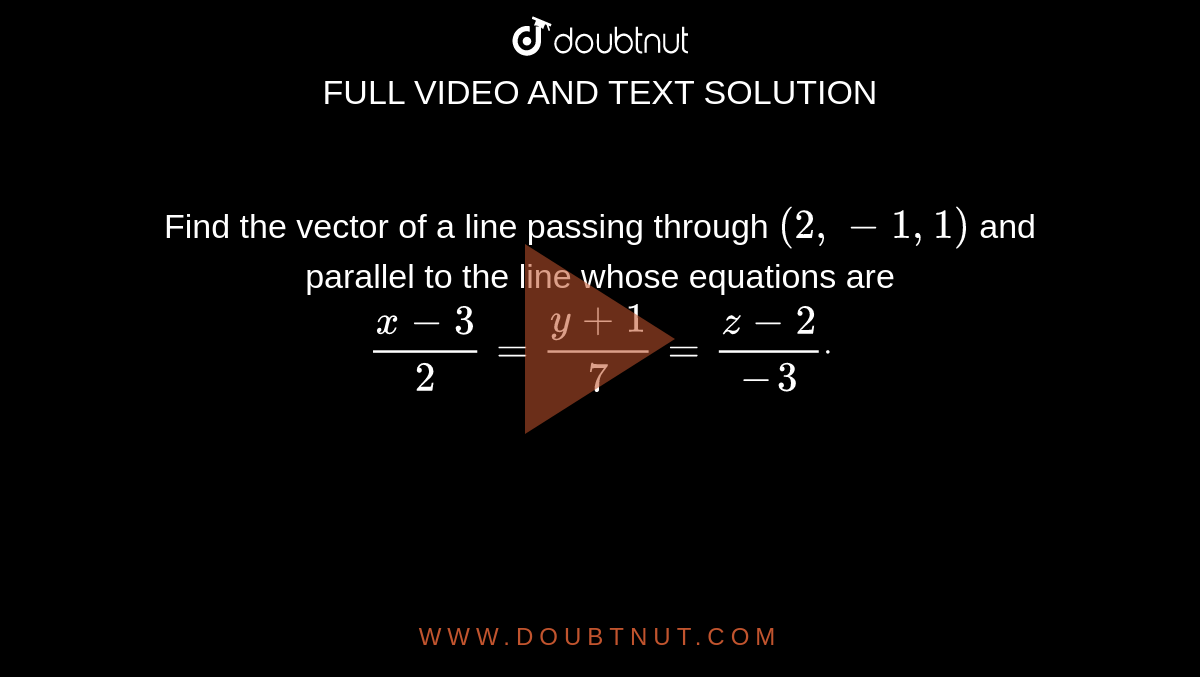
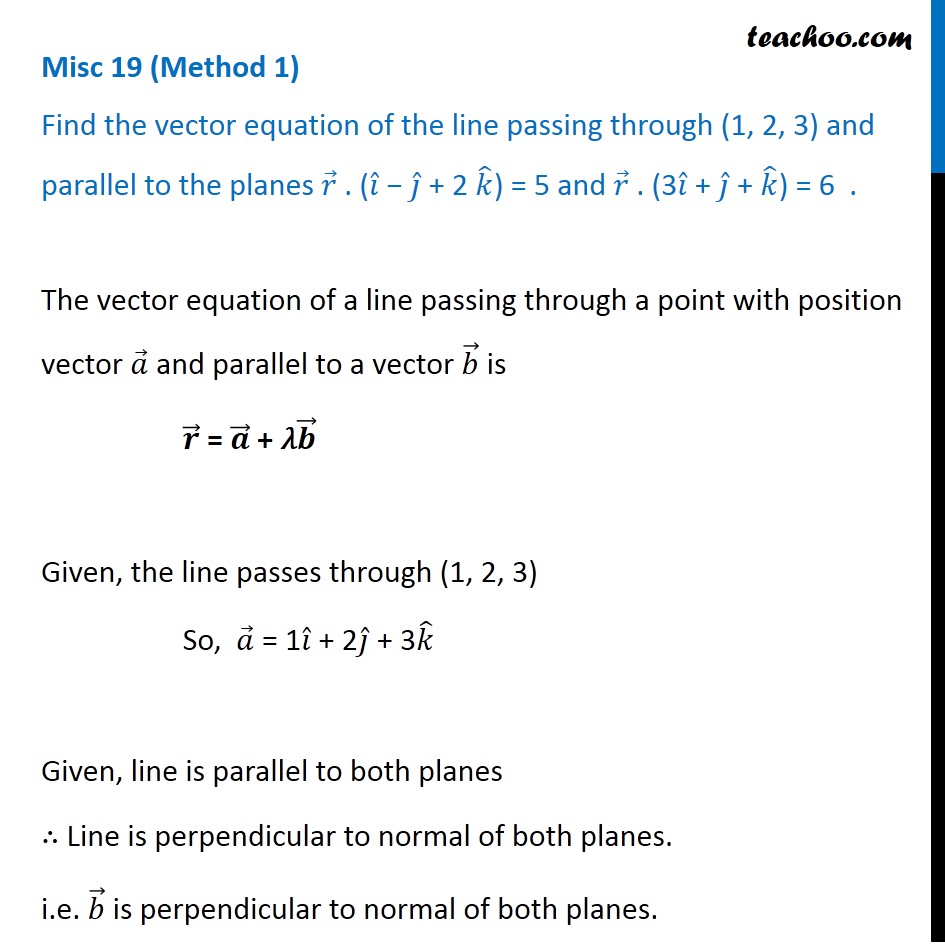
Passing Through And Parallel To The Line Whose Equation Is

Find Any Equation Parallel to the Line y=5x-2. y = 5x − 2 y = 5 x - 2. Choose a point that the parallel line will pass through. (0,0) ( 0, 0) Use the slope-intercept form to f...

Przechodzenie przez i równoległe do linii o równaniu jest ważnym tematem w matematyce. Aby zrozumieć, jak to działa, musimy najpierw zrozumieć, czym jest równanie. Równanie jest wyrażeniem matematycznym, które jest używane do określenia wartości zmiennej w zależności od innych zmiennych. W przypadku linii równanie jest wykorzystywane do określenia wszystkich punktów, które leżą na tym samym poziomie.
Aby zrozumieć, jak przechodzić przez i równolegle do linii o równaniu, należy zrozumieć, w jaki sposób równanie jest używane do określenia wszystkich punktów na linii. Równanie linii jest zwykle wyrażone jako y = mx + b, gdzie m jest współczynnikiem kierunkowym, a b jest wyrazem wolnym. Współczynnik kierunkowy wskazuje kierunek linii, a wyraz wolny określa jej położenie na osi x.
Aby przejść przez linię o równaniu, musimy znaleźć punkt startowy, który będzie leżał na linii. Aby to zrobić, wykorzystamy wyrażenie y = mx + b. Musimy określić wartość m i b, a następnie użyć tej informacji do określenia punktu startowego. Punkt startowy jest punktem, który spełnia wszystkie warunki równania.
Następnie musimy określić, w którym kierunku chcemy przesunąć punkt startowy. Możemy to zrobić, dodając lub odejmując wartości od punktu startowego. Możemy również dodać lub odejmować wartości od współczynnika kierunkowego i wyrazu wolnego. Dodanie lub odejmowanie wartości do współczynnika kierunkowego lub wyrazu wolnego powoduje przesunięcie linii w górę lub w dół.
Aby przejść równolegle do linii o równaniu, musimy znaleźć punkt startowy, który leży na tej samej linii co punkt startowy dla przechodzenia przez linie. Następnie musimy określić, w którym kierunku chcemy przesunąć punkt startowy. Możemy to zrobić, dodając lub odejmując wartości do współczynnika kierunkowego lub wyrazu wolnego. Jeśli dodamy lub odejmiemy taką samą wartość do
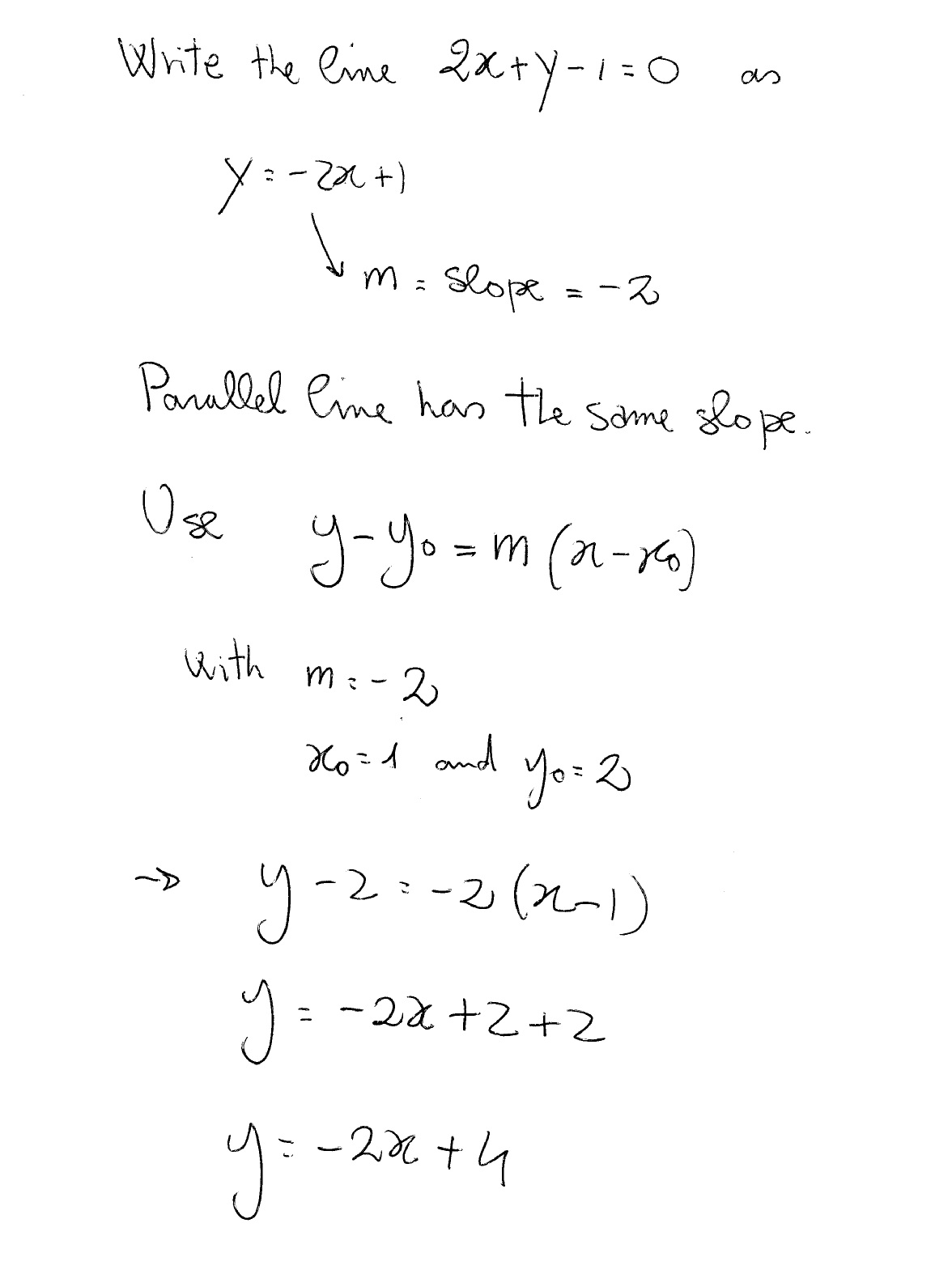
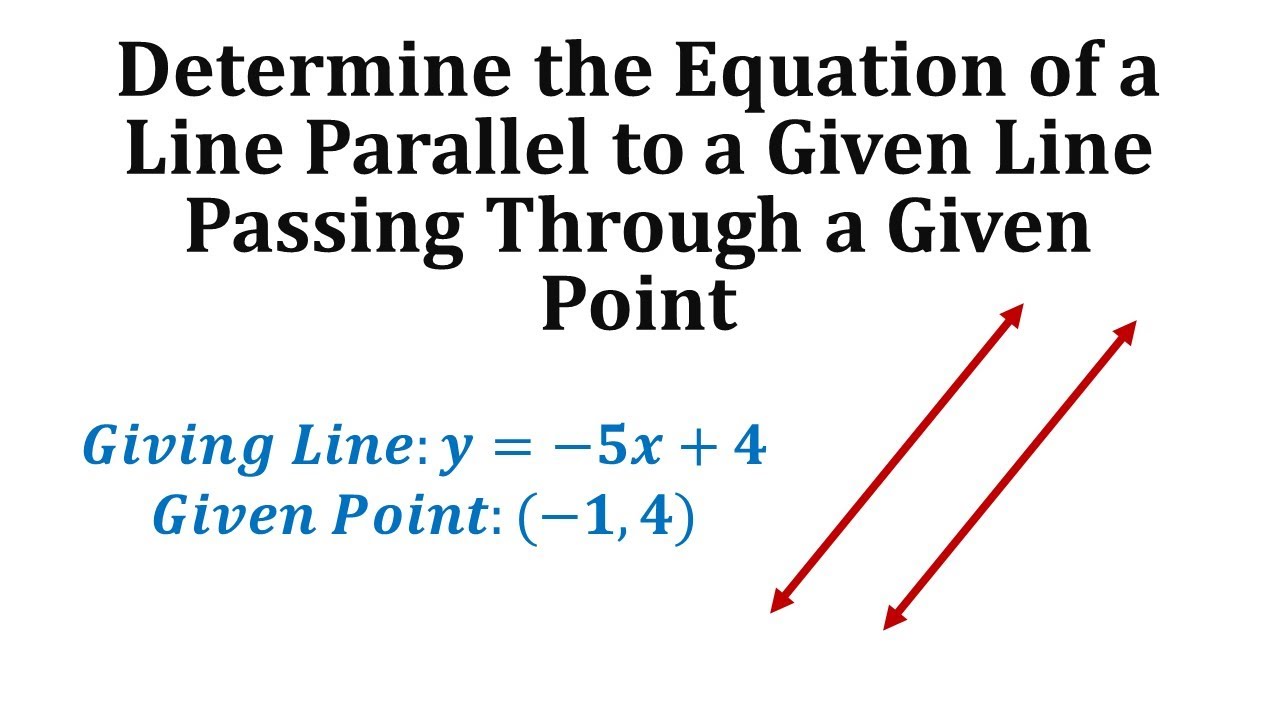
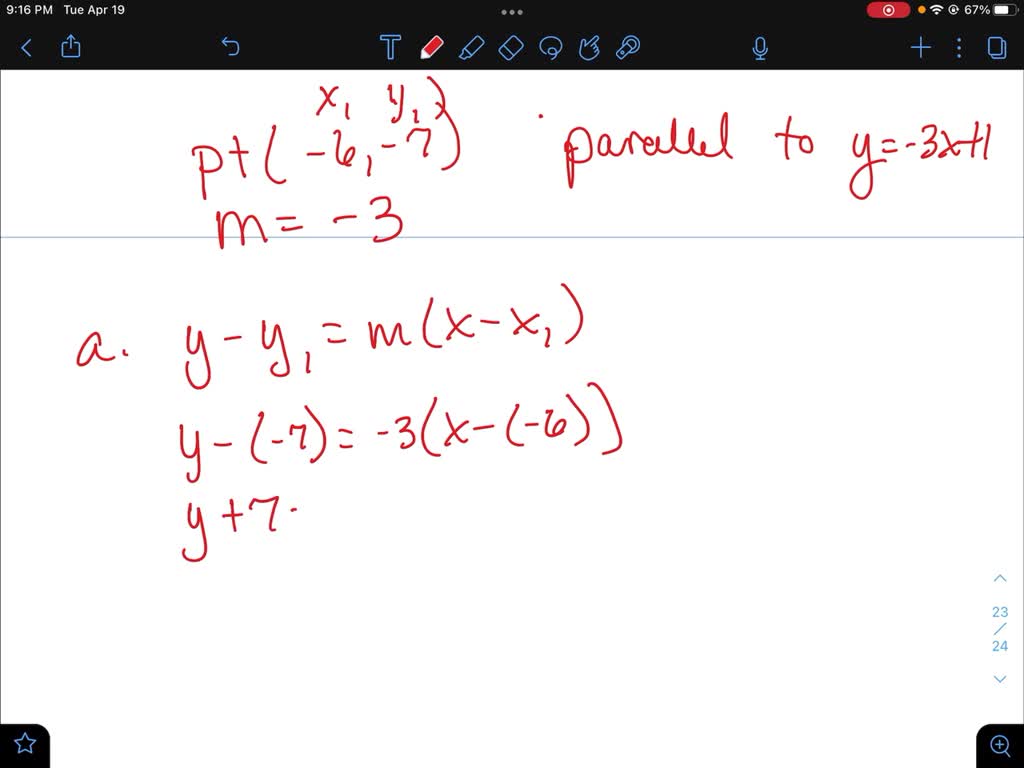
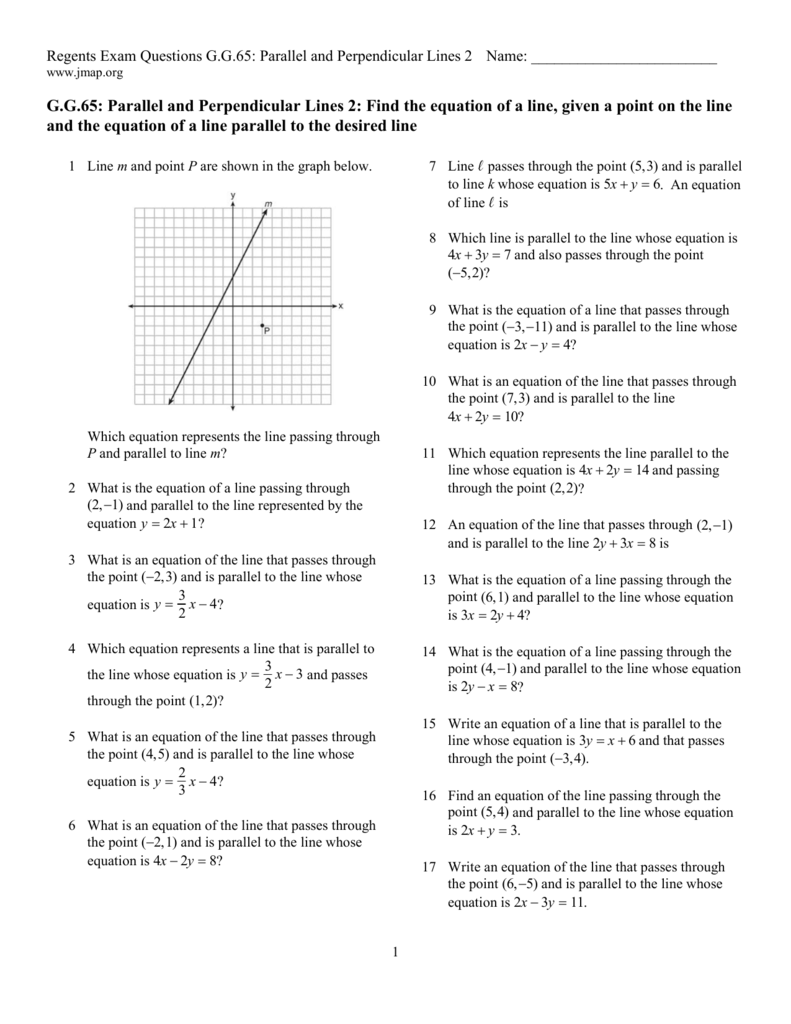
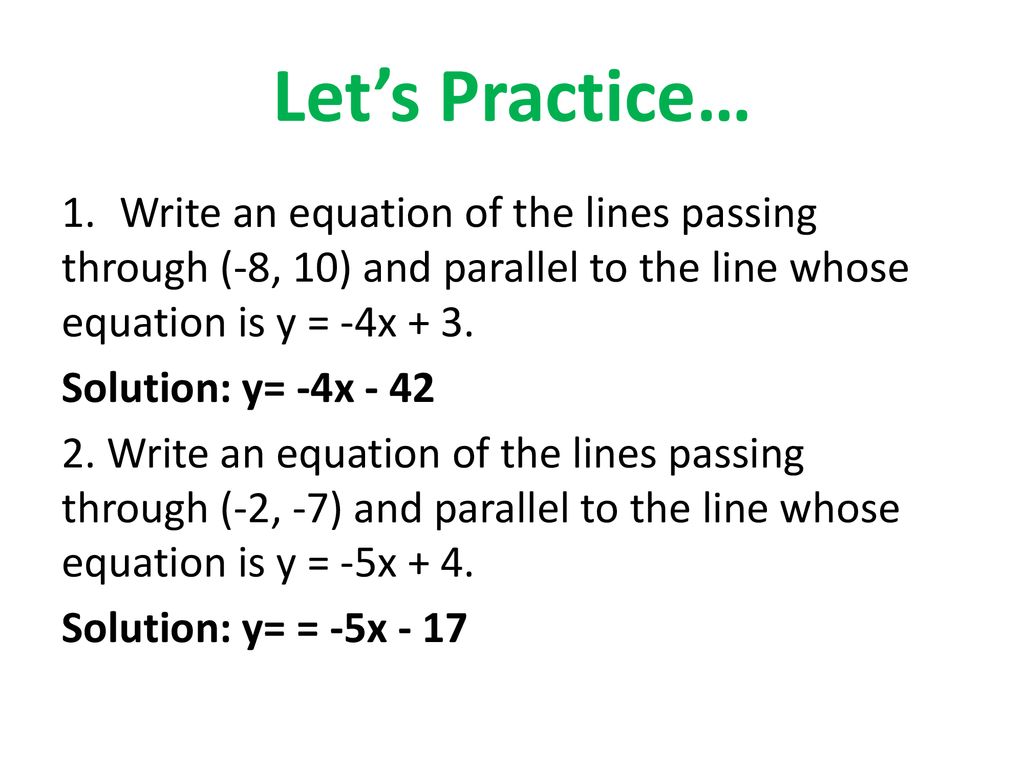
Find Any Equation Parallel to the Line y=5x-2. y = 5x − 2 y = 5 x - 2. Choose a point that the parallel line will pass through. (0,0) ( 0, 0) Use the slope-intercept form to find the. Passing through (-2,-7) and parallel to the line whose equation is y = -5x + 4-----The given line has a slope = -5 Any line parallel to it must have a slope of -5-----Equation. Parallel lines have the same slope. So our line should have a slope of 2x. Next we use the point slope formula to find the equation of the line that passes through and is.
Parallel Lines have the SAME SLOPE. We first Find the Slope of the line y = 2x + 3. The Slope Intercept Form of the equation of a given line is: y = mx + c. where. 143K views 9 years ago. Finding the equation of a line parallel to another line. This video is provided by the Learning Assistance Center of Howard. Find Any Equation Parallel to the Line y=3x-4 | Mathway. Free math problem solver answers your algebra, geometry, trigonometry, calculus, and statistics homework.
Slope of the line m1 = -2 . We know that the parallel lines have a equal slope . m2 = -2 . The given point is (4,4) So the point - slope form of equation is y – y1. Now for the line which is our reference, we have the equation as; y = x. Comparing this with the general equation of a straight line which is y = mx + c. where. y = 2x - 6; point-slope form. Answer by mananth (16105) ( Show Source ): You can put this solution on YOUR website! Passing through (3,4) and parallel to the line whose.
Step 1. Substitute the slope from original line (3 in this case) into the equation of the line. y = 3 x + b. Step 2. Substitute the given point (1, 7) into the x and y values. y = 3. So, to find an equation of a line that is parallel to another, you have to make sure both equations have the same slope. In the general equation of a line y = mx + b , the m. what is the equation of a line passing through the point (6,1) and parallel to the line whose equation 3x=2y+4 Answer: When the slope of two lines is equal, then the.